Discounts and Protection Drive Adoption
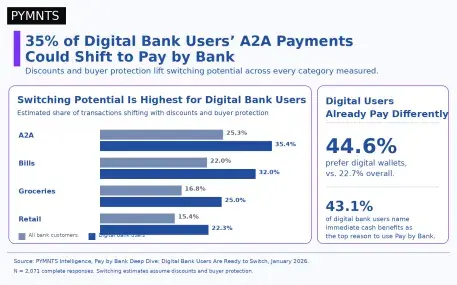
A recent survey by PYMNTS Intelligencer shows that customers of digital banks are far more inclined to use Pay‑by‑Bank for their monthly bills than the average banking customer, especially when the service offers price reductions and buyer protection. The study, conducted in October 2026, surveyed 3,200 adults across the United States, comparing preferences between digital‑only bank users and traditional bank customers.
Breaking news
 X Money Launches with High-Yield Savings and Cashback Rewards
 Splitit Announces White-Label Credit Card Launch
 Billing Friction Puts $12.3 Billion in Auto Loan Payments at Risk
 OneSpan Unveils New e‑Signature Features Including Identity Wallets and AI Workflow Support
The research found that 32 % of digital bank users would switch to Pay‑by‑Bank for their recurring payments if they received a discount on the transaction fee and a guarantee that the bill would be paid on time. In contrast, only about 12 % of customers from conventional banks expressed the same willingness. The willingness to switch was highest among younger adults, with 40 % of those under 35 showing interest, compared to 20 % of those over 55.
Will Pay‑by‑Bank Become the New Standard for Bills?
The study highlights that price incentives and security features are the main drivers behind the higher adoption rates among digital bank customers. „When we asked participants what would make them use Pay‑by‑Bank, the top two responses were a discount on the payment fee and a buyer‑protection guarantee,” said the research lead, Maya Patel. „Digital bank users are accustomed to low‑fee, tech‑driven services, so they are more receptive to these benefits.”
In the survey, 28 % of respondents said they would only consider Pay‑by‑Bank if the service offered a 5 % discount on the transaction fee. A further 18 % cited the need for a buyer‑protection policy that covers late payments or incorrect amounts. Traditional bank customers, meanwhile, were more concerned with the integration of the service into their existing banking app and the convenience of automatic bill reminders.
What does this mean for the future of bill payments? The data suggest that if Pay‑by‑Bank providers can bundle cost savings and robust protection, they could capture a significant share of the market, especially among tech‑savvy, younger consumers. „We’re seeing a shift toward frictionless, fee‑free payment methods,” said Patel. „If the industry can align incentives with consumer expectations, Pay‑by‑Bank could become the default for many recurring payments.”
Frequently Asked Questions
The potential market impact is substantial. Bill payment volumes in the United States reached $1.2 trillion in 2025. A 32 % share would translate to $384 billion in annual transactions. Providers that can secure this volume will need to partner with banks that already serve digital‑only customers and invest in marketing campaigns that emphasize discounts and protection.
The survey also noted that digital bank customers are more likely to use mobile‑first solutions. Therefore, integrating Pay‑by‑Bank into mobile apps with seamless checkout flows could further boost adoption. Traditional banks may need to rethink their fee structures and offer similar incentives to remain competitive.



